Aluminium CNC Design
Surveys indicate that 5-axis machining centers now account for over 20% of market demand, while 81% of users identify adaptive machining as their top priority for smart manufacturing initiatives.
Product Description
Aluminum CNC Design | Precision CNC Aluminum Machined Parts | Custom 5-Axis Milling Services
According to the latest manufacturing industry insights report for 2026, the global aluminum CNC machining market is projected to reach a size of $1.587 billion by 2032, exhibiting a Compound Annual Growth Rate (CAGR) of 8.8%. Concurrently, demand for CNC-machined aluminum parts is experiencing explosive growth in high-end manufacturing sectors, such as new energy vehicles and robotics. Surveys indicate that 5-axis machining centers now account for over 20% of market demand, while 81% of users identify adaptive machining as their top priority for smart manufacturing initiatives. Against this backdrop, our aluminum CNC design services are designed to assist engineers and procurement specialists in addressing three core challenges:
How to design truly manufacturable aluminum parts—avoiding common design pitfalls.
How to select the most suitable aluminum alloy grade—balancing strength, cost, and machinability.
How to shorten lead times while ensuring precision—achieving rapid delivery through design optimization.
From prototyping to mass production, we offer comprehensive, one-stop services covering the entire process—from material recommendations and DFM (Design for Manufacturability) reviews to surface finishing.
Guide to Aluminum Alloy Selection
Not all aluminum alloys perform identically during machining. Different alloy grades exhibit vast differences in behavior when interacting with cutting tools—some cut as smoothly as butter, while others present significant machining challenges at every step. Our commonly used CNC aluminum alloy grades include:
| Grade | Characteristics | Typical Applications |
| 6061-T6 / T651 | The most versatile aluminum alloy; excellent strength-to-weight ratio, outstanding machinability, naturally corrosion-resistant | Automotive components, industrial equipment, consumer electronics |
| 7075-T6 / T7351 | High strength and hardness (comparable to steel), excellent fatigue resistance | High-stress structural components, competitive sports equipment |
| 5052-H32 | Excellent corrosion resistance, moderate strength, good machinability | Marine environments, chemical equipment, pressure vessels |
| 2024-T351 | High fatigue strength; parts requiring high fatigue resistance |
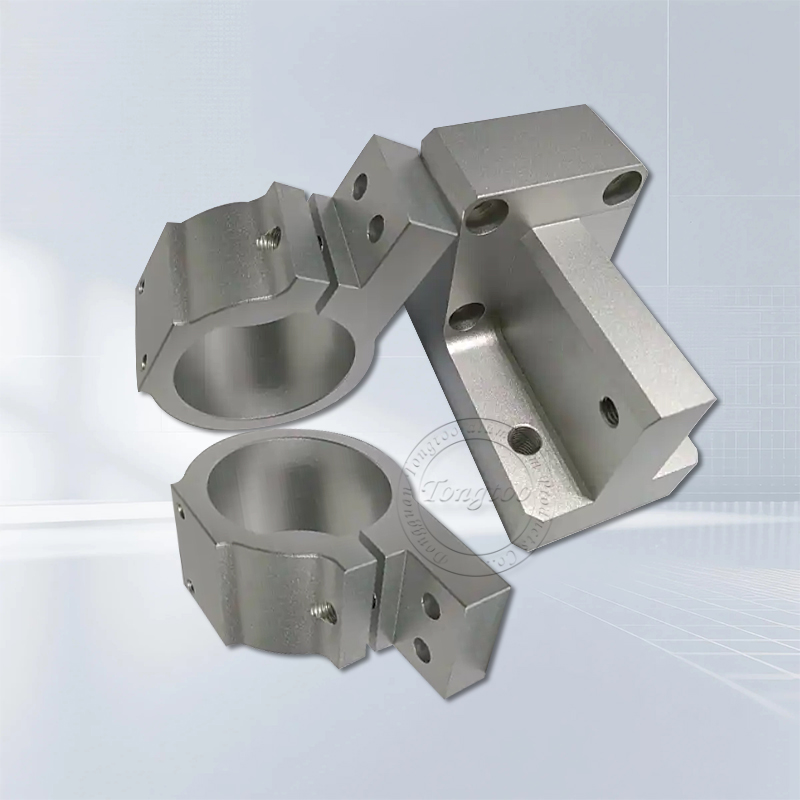
Aluminum alloy structural components
|
Design for Manufacturability (DFM) — The Secret to Cost Reduction: Studies indicate that by optimizing the design for CNC aluminum machining, costs can be significantly reduced and lead times shortened. Design Best Practices
| Design Principle | Recommended Parameter | Explanation |
| Maintain Consistent Wall Thickness | ≥0.5mm (Aluminum) | Recommended: ≥1.0mm to prevent thin-wall deformation and vibration. |
| Avoid Sharp Internal Corners | Internal Fillet Radius ≥ 1/3 of Cavity Depth | Reduces stress concentration and tool wear. |
| Control Cavity Depth | Depth ≤ 4 × Width | Prevents tool deflection. |
| Use Standard Thread | Hole Sizes | Hole Depth ≤ 3–4 × Hole Diameter | Avoids chip evacuation difficulties. |
| Simplify Geometry | Avoid Unnecessary Complex Curves | Optimizes tool paths and accelerates production. |
Common Design Errors (Must Be Avoided)
Designing extremely thin or non-uniform walls.
Sharp internal corners (which cannot be precisely machined using cylindrical milling cutters).
Excessively deep, small-diameter holes (leading to tool deflection).
Complex geometries requiring multiple fixturing operations (increasing time and cost).
Complex features that fall outside the access range of standard tooling.
Machining Precision and Tolerance Capabilities
We offer precision tolerance capabilities that meet international standards:
| Tolerance Class | Parameter |
| Standard Tolerance | ±0.025mm |
| Precision Tolerance | ±0.005mm |
| Hole Diameter Tolerance | H6–H7 |
| Positional Tolerance | ±0.01mm |
| Surface Roughness | Ra 0.8–1.6 μm (Precision machining can achieve Ra 0.4 μm) |
In accordance with ISO 2768 standards, our linear tolerance ranges from ±0.05mm to ±0.2mm, depending on the complexity of the part and the requirements for critical dimensions.
For critical dimensions—please clearly specify the required tolerances. Precision tolerances require stricter process control; therefore, it is recommended to clearly mark them on the technical drawings.

Surface Treatment and Post-Processing Options
| Surface Treatment | Application Advantages |
| Anodizing | Enhances corrosion resistance, increases hardness, offers a variety of color options |
| Sandblasting | Uniform matte finish, conceals machining marks |
| Polishing | High-gloss reflective surface, suitable for aesthetic parts |
| Chemical Conversion Coating | Conductive protective layer, suitable for electronic components |
| Powder Coating | Highly abrasion-resistant, colorful finish |
Aluminum naturally possesses excellent corrosion resistance, while anodizing can further enhance its surface hardness and aesthetic appeal.
Equipment Capabilities
Our CNC Processes:
CNC Milling (3-axis, 4-axis, 5-axis) — Suitable for complex geometries, cavities, curved surfaces, and contours
CNC Turning — Suitable for cylindrical parts, shafts, and fasteners
Drilling & Threading — Precise hole machining and thread insertion
Our Machining Dimensions: Up to 4500mm × 500mm × 500mm (for aluminum)
Why Choose Us?
One-Stop Service from Design to Mass Production — We go beyond mere machining; we also provide DFM (Design for Manufacturability) review recommendations starting from the design phase.
Multi-Industry Experience — Proven track records in the automotive, robotics, electronics, and new energy vehicle sectors.
Rapid Prototyping — A fast bridge connecting digital designs to physical reality.
Quality Control System — Utilizing professional tools, such as CMM (Coordinate Measuring Machines), for comprehensive inspection throughout the entire process.
Global Delivery Capabilities — Machining and delivery capabilities that meet international standards.