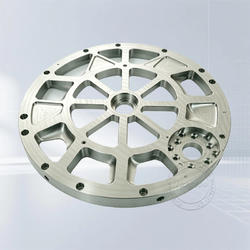
5-Axis CNC Milled Parts
In the competitive landscape of modern high-end manufacturing, the precision of a single part often determines the performance of the entire system.
Product Description
The Art of Precision Manufacturing: Unlocking Infinite Possibilities for Complex Surfaces
In the competitive landscape of modern high-end manufacturing, the precision of a single part often determines the performance of the entire system. From engine blades soaring through the skies to critical life-saving medical components, and from lightweight structural parts for new energy vehicles to the intricate cavities of precision molds—these "jewels" of modern industry all rely on a revolutionary manufacturing technology: 5-axis CNC milling.
From 3-Axis to 5-Axis: A Revolution in Machining Methods
To understand the value of 5-axis machining, we must look back at the evolution of CNC machining. While traditional 3-axis CNC milling machines (featuring X, Y, and Z linear axes) are technologically mature and highly reliable, they reveal distinct limitations when handling workpieces with complex curved surfaces. These include lengthy machining paths, the need for frequent re-clamping, accumulated positioning errors caused by fragmented processes, and a high risk of collisions between the tool and the workpiece or fixture.
The 5-axis CNC machining center evolved directly from the 3-axis milling machine. By adding two rotary axes (typically the A-axis rotating around the X-axis, and the B- or C-axis rotating around the Y- or Z-axis) to the standard X, Y, and Z linear axes, the cutting tool can machine complex features with greater precision from multiple angles.
For decades, 5-axis CNC machining technology has been regarded as the premier method for machining continuous, smooth, and complex surfaces. It represents not only a true watershed moment for the machine tool industry but also a fundamental shift in precision manufacturing—moving from a reliance on manual craftsmanship to a reliance on advanced technology.
Core Advantages of 5-Axis CNC Milling
Complete machining with a single setup. One of the greatest advantages of 5-axis machines is their ability to produce complex workpieces and precision components in a single setup in most cases. Once clamped, the workpiece can undergo multiple operations—such as milling, boring, drilling, and surface contouring—without being moved. This effectively eliminates positioning errors caused by repeated setups, shortens production cycles, and enhances machining precision.
Optimal cutting angles and superior surface quality. Five-axis technology enables the cutting tool to maintain an optimal cutting angle and linear cutting speed at all times, significantly improving the surface finish (Ra value). For the same surface precision requirements, the distance between milling tool paths (step-over) is much larger in five-axis machining than in traditional three-axis machining, drastically reducing the time required to machine free-form surfaces. Five-axis or four-axis CNC machining can achieve a fine mirror-like finish with an Ra value as low as 0.4 µm, whereas the minimum roughness achievable with three-axis milling is only 1.6 µm.
Higher efficiency and lower costs. It eliminates the need for special fixtures, thereby reducing fixture costs; it removes the need for many specialized tools, lowering tooling costs; material removal rates are faster; and complete machining is achieved in a single setup, significantly shortening processing times. When machining highly complex workpieces (such as turbine blades or marine propellers), the production efficiency of five-axis machining can be tens or even hundreds of times higher than that of traditional machining.
Types of 5-Axis Machining
Based on the movement of the axes during the cutting process, five-axis machining is generally categorized into the following three types:
1. Indexing (3+2 axis) machining. During cutting, the machine moves only along the three linear axes (X, Y, and Z), while the two rotary axes are used to position the tool or workpiece at a fixed angle before cutting begins. This method is suitable for prismatic parts with angular features.
2. Continuous 5-axis simultaneous machining. All five axes move simultaneously during the cutting process, with the tool and workpiece moving in a smooth, coordinated manner. Continuous five-axis machining is the superior choice for components requiring extremely high surface quality and dimensional consistency, such as turbine blades and medical device parts.
3. 5-axis turn-mill machining. This integrates turning and milling operations into a single machine, making it suitable for machining high-precision shafts, connectors, and complex rotational parts.
Technical Specifications and Precision Parameters
5-axis CNC milled parts are renowned for their micron-level machining precision. Typical technical specifications for reference: X/Y/Z-axis positioning accuracy: 0.002 mm
X/Y/Z-axis repeatability: 0.0018 mm
A/C-axis positioning accuracy: 8 arc-seconds
A/C-axis repeatability: 5 arc-seconds
Maximum spindle speed: 20,000 rpm
Surface roughness (Ra): Achievable range of 0.1–0.4 μm
Machining accuracy: Micron-level
Some high-end 5-axis machining centers offer volumetric accuracy better than 15 μm, support workpiece weights up to 40 tons, and provide travel ranges up to 6 meters. Linear axis accuracy can reach 2 μm, and rotary axis accuracy can reach 4 arc-seconds.
Wide Range of Applications
5-axis CNC milling technology is widely used in various high-end manufacturing sectors:
Automotive manufacturing: High-efficiency, high-precision machining of automotive body panel molds, die-cast parts, and powertrain components.
Medical equipment: Precision medical device parts, structural components, and other parts requiring exceptional precision and surface quality.
Mold making: Precision molds, complex cavities, electrode machining, etc.
New energy and semiconductors: Wind power components, core parts for hydrogen-powered vehicles, semiconductor vacuum chamber machining, etc. Additionally, 5-axis machining is widely applied in shipbuilding, energy, 3C electronics, robotics, and other fields.
Material Capabilities and Surface Finishing
5-axis CNC milling supports a wide range of metal and plastic materials, including:
Metals: Aluminum alloys (5052, 6061, 6063, 7075, etc.), stainless steel (303, 304, 316, etc.), titanium alloys, brass, bronze, hardened metals, alloy steels, etc.
Surface finishing: Various processes available, such as anodizing, sandblasting, polishing, brushing, chrome plating, powder coating, etc. Precision tolerance: Achievable within ±0.01 mm or tighter.

Why Choose 5-Axis CNC Milled Parts
Precision: Micron-level machining accuracy, meeting the most stringent dimensional and geometric tolerance requirements. Efficiency: Complete all machining operations in a single setup, significantly shortening production cycles.
Quality: Achieve superior surface finishes, reducing or even eliminating the need for subsequent polishing.
Complexity: Easily handle features—such as complex curved surfaces, deep cavities, and angled holes—that are beyond the capabilities of traditional 3-axis machining.
Reliability: Minimize setups and eliminate cumulative errors, ensuring consistent quality across batch production.
Flexibility: Compatible with a wide range of metals and plastics, meeting the customized needs of diverse industries.
5-axis CNC milling is more than just a machining technique; it represents the pinnacle of precision manufacturing capabilities. From early CNC milling machines to today’s high-end 5-axis simultaneous machining centers, this technology embodies the ingenuity and craftsmanship of generations of engineers. Choosing 5-axis CNC milling means choosing the perfect combination of precision, efficiency, and quality.
For more information on custom 5-axis CNC milling services, material selection, or technical consultation, please feel free to contact our customer service team.